Johannes
Brahms
(1833-1897)
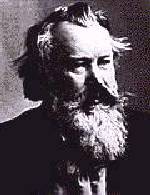
Johannes
Brahms was a German composer who gave the world a body of
great music: chamber and piano works, three concertos, four
very beautiful symphonies and other orchestral works, a requiem in the German
language and other choral compositions, lieder and
arrangements of folks songs.
|
|
|
As
a young man, Brahms was befriended by Schumann, who after
meeting the 20-year old composer and hearing him play his
C-Major piano sonata, rightly pronounced him a genius.
Brahms was largely self-taught, carefully studying the masters
who proceeded him such as Bach, Mozart and Haydn, and even the
great composers going back to the Renaissance period. His
breadth of studies was truly amazing: Caldara, non Papa, Gabrieli, Hassler,
Victoria, Lassus, Marenzio,
Palestrina,
Praetorius, Schutz, Cherubini and Gluck. He amassed a
collection of music and music books that numbered in the
thousands, some of these being very valuable. He was the owner
of the autograph score of Mozart's G minor Symphony, K550,
Haydn's opus 20 String Quartets and the sketchbook that
included sketches for Beethoven's masterful hammerklavier
piano sonata. He also had a lifetime interest in folk music
and was a tremendous melodist. Tunes he learned from his
friend Eduard Reményi, from books and from Hungarian cafe
musicians became his famous Hungarian Dances that helped earn
him enough money to pursue music composition without having to
pander to other tastes, and to work at his studies without
having to struggle for income.
Brahms continued the tradition of Beethoven in his symphonic
and chamber works, but because he lived in the time of Liszt
and Wagner, he was heavily condemned for writing in style that
was considered out-of-date. Critics also accused Brahms of
being an inadequate orchestrator, writing that his symphonies
lack the color found in the scores of other composers, such as
Berlioz and Rimsky-Korsakoff. In fact, during the second half
of the 19th Century, instrumental color became an important
aspect of musical composition, and this tendency was fully
realized later in the works of Ravel. But in truth, Brahms
orchestrated his symphonies very suitably, in a manner that
did not detract from the brilliant music itself, as Brahms
was, next to Beethoven, perhaps the greatest developer and
expander of melody of all composers.
Web Sites
A Brahms Web Site
Johannes
Brahms Org
Selected
Compositions on CD
Clarinet Quintet
Hungarian
Dances
Ein Deutsches
Requiem |